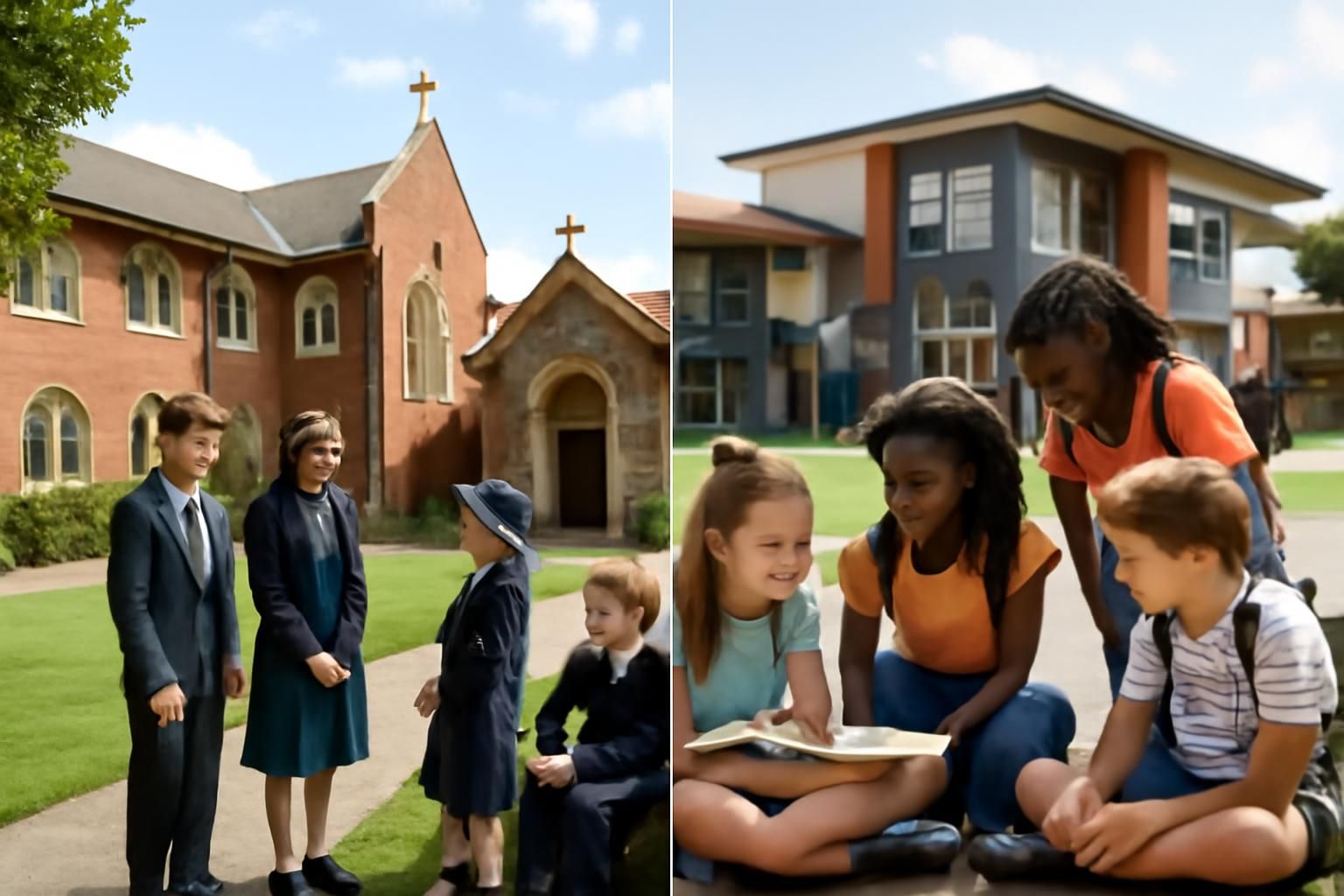
The Australian education landscape features a rich tapestry of options, with Catholic schools and public schools constituting two of the most significant sectors. Choosing between these school types involves assessing various factors such as curriculum, fees, school environment, faith aspects, and student outcomes. Each sector has unique benefits, reflecting the diverse needs and values of Australian families. Catholic schools emphasize faith-based education and community values, while public schools offer broad accessibility and reflect the multicultural fabric of local communities. This comparison aims to clarify these differences by examining key elements shaping educational experiences in Australia.
Briefly put, parents and guardians deciding on a school should consider:
- Cost differences: Public schools are mostly free; Catholic schools involve moderate fees.
- Curriculum and ethos: Both sectors follow the Australian Curriculum, but Catholic schools integrate faith and values education.
- School environment: Public schools are diverse and inclusive; Catholic schools emphasize pastoral care and community spirit.
- Enrolment criteria: Public schools often operate on catchment zones, whereas Catholic schools have their own enrolment priorities.
- Extracurricular advantages: Both sectors offer varied programs, but Catholic schools often provide additional faith-based activities.
Governance and Funding: Foundations of Catholic and Public Schools in Australia
Understanding the governance structure and funding models behind Catholic and public schools in Australia is essential to grasp their operational differences. Public schools are managed and funded by respective state and territory governments, making them the primary choice for about 65% of Australian students. These schools are fully government-funded, which means that tuition is free for Australian citizens and permanent residents, although voluntary contributions for resources may be requested by individual schools.
Catholic schools operate under the auspices of various dioceses and religious orders, representing the largest non-government sector, educating about 20% of Australian students. Systemic Catholic schools are coordinated by diocesan authorities, making them more accessible with tuition fees generally ranging between AUD $1,500 and $6,000 annually. Independent Catholic schools like Loreto or Xavier College function autonomously and tend to charge higher fees, sometimes exceeding AUD $25,000 a year.
Both sectors rely on a mixture of funding; while public schools are almost exclusively financed by government budgets, Catholic schools receive subsidies from both the government and tuition fees paid by families. This dual model affects the resources available and can influence the range of programs schools can offer. It’s important to note that this difference in funding does not necessarily reflect in academic outcomes but may impact facilities, extracurricular programs, and class sizes.
Governance also shapes enrolment policies. Public schools operate primarily on a catchment zone system, guaranteeing local children access, whereas Catholic schools have their own admissions processes, often prioritizing children from Catholic families but remaining open to students of all backgrounds.
Curriculum Structure and Faith-Based Education: Contrasts and Complements
Both Catholic and public schools in Australia follow the Australian Curriculum, ensuring students learn foundational academic subjects such as English, Mathematics, Science, and Humanities. This uniformity assures parents that students receive an education that meets national standards regardless of sector.
However, a significant differentiator lies in the integration of faith-based education. Catholic schools incorporate Religious Education (RE) classes, regular participation in Mass and liturgies, and spiritual development programs that enrich the traditional curriculum. These programs foster a sense of community and encourage moral and ethical development grounded in Catholic values, emphasizing social justice and care for others.
Public schools maintain a secular curriculum, respecting Australia’s diverse religious landscape without incorporating formal religious instruction. This approach aligns with their role serving highly multicultural communities, promoting inclusiveness while avoiding religious affiliation. Nonetheless, public schools often provide religious instruction or values education through optional external programs or community partnerships, allowing families to introduce faith considerations outside formal school hours.
The curriculum differences extend to how each sector supports student wellbeing. Catholic schools tend to highlight pastoral care, often facilitated through smaller school communities and faith-driven support structures. Public schools deploy inclusive education frameworks targeting diverse needs, from English as an Additional Language or Dialect (EAL/D) support to gifted and disabled education programs. These differences illustrate each sector’s tailored approach to nurturing children academically and personally.
Financial Considerations: Tuition Fees, Additional Costs, and Accessibility
A major consideration for families when choosing between Catholic and public schools is the financial investment required. Public schools are predominantly tuition-free for Australian citizens and permanent residents, with any required contributions being voluntary and typically modest. These schools rely heavily on government funding, with additional expenses including uniforms, extracurricular activities, excursions, and technology occasionally incurring small fees.
In contrast, Catholic schools require payment of tuition fees and levies, although these tend to be lower than those of fully independent private schools. As highlighted earlier, fees in systemic Catholic schools range widely but are often structured to remain affordable to a broad community base. Means-tested concessions and payment plans are commonly available to assist families facing financial challenges.
When budgeting for school costs, families need to consider:
- Tuition and levies: Core fees necessary for enrolment.
- Uniforms and supplies: Required school uniforms vary between AUD $150 and $400 annually.
- Excursions and camps: Activities outside the classroom can add several hundred dollars yearly.
- Technology and resources: Some schools request contributions for iPads, laptops, or learning materials.
- Extra curricular involvement: Sports, arts, and academic clubs can involve additional costs.
This financial landscape means public schools provide a more accessible option for families with budget constraints, while Catholic schools offer a balance between affordability and a faith-based educational environment that some families value highly.

Student Outcomes and Academic Performance Across School Types
A hotly debated topic in school comparison discussions is whether Catholic schools or public schools achieve better academic results. It is important to understand data within context, considering factors like socio-educational advantage, resources, and specialised programs.
Standardised assessments like NAPLAN (National Assessment Program – Literacy and Numeracy) offer a snapshot of academic performance in Australian schools. Studies indicate that when socio-economic status is accounted for, many public schools perform on par with or outperform some Catholic and independent schools in student outcomes.
Notably, selective government schools—public schools that admit students based on academic merit—regularly rank among the top in NAPLAN results and university entrance scores. Meanwhile, many Catholic schools also maintain strong academic records, often supported by tight-knit school communities and emphasis on holistic development.
Academic excellence does not reside exclusively in one sector. Instead, the school environment, quality of teaching, and alignment with student learning needs play critical roles. For instance, a child thriving in a supportive, values-oriented Catholic school environment may do better than at a larger secular public school where individual attention is harder to achieve, and vice versa.
School Environment and Culture: Community, Diversity, and Inclusivity
The social environment of a school greatly influences student wellbeing and engagement. Public schools in Australia typically reflect the broad diversity of Australian society, with students from a wide range of cultural, linguistic, and socio-economic backgrounds. This diversity fosters inclusiveness and prepares students for life in a multicultural society.
In contrast, Catholic schools often cultivate close communities bound by shared values and faith traditions. Their pastoral care models emphasize developing the whole child, caring for mental health, and instilling a sense of social responsibility. Many parents choose Catholic schools for this community focus and supportive atmosphere, which nurtures both academic growth and personal development.
Both sectors promote co-curricular activities such as sports, arts, and science clubs. Catholic schools often include religious activities as part of their extracurricular offerings, while public schools may offer extensive programs driven by student interests and community partnerships. This diversity of activities benefits students by encouraging exploration of talents and fostering teamwork skills.
The Role of Enrolment Policies and School Accessibility
Enrolment criteria differ fundamentally between Catholic and public schools. Public schools commonly enrol students based on catchment areas defined by residential addresses, ensuring local children receive education close to home. This zonal system facilitates easy access, but can limit choice if a family desires a school outside its designated zone.
Catholic schools operate independently regarding enrolment and may require applications, interviews, or prioritization of Catholic families. Though open to non-Catholics, evidence of faith or baptismal certificates may be requested to secure admission, especially in popular schools with limited places. This system can challenge families unfamiliar with the application process, but offers greater choice beyond geographical constraints.
Understanding these enrolment structures is crucial for families to align their choices with practical requirements and values. A comprehensive guide on differences between Catholic and state schools provides valuable insights into navigating these processes effectively.
Extracurricular and Pastoral Benefits in Catholic vs. Public Schools
Both school types provide extracurricular programs that enhance students’ education beyond the classroom. Public schools offer a strong variety of clubs, sports teams, and academic competitions. Their scale and diversity enable broad participation, though resources and extracurricular breadth vary according to localized funding and school size.
Catholic schools frequently integrate activities that support faith-based education, such as community service, religious retreats, and choir groups, alongside sports and arts opportunities. These programs contribute to character formation and help students develop a strong sense of identity and ethical responsibility.
The impact of these activities on student development is significant. For example, participating in community service programs organized by Catholic schools fosters empathy and social awareness. Similarly, public schools’ inclusive sports and arts programs encourage teamwork and skill development in diverse groups.
Comparative Overview of Catholic and Public Schools in Australia
| Aspect | Public Schools | Catholic Schools |
|---|---|---|
| Governance | Operated and funded by state/territory governments | Managed by Catholic dioceses and religious orders |
| Tuition Fees | Free; voluntary contributions | Moderate fees (from AUD $1,500 to $6,000+ per year) |
| Curriculum | Australian Curriculum (secular) | Australian Curriculum + Religious Education |
| Enrolment | Based on local catchment zones | Own enrolment policies; Catholic priority |
| Student Diversity | High cultural and socio-economic diversity | Moderate diversity; community sharing Catholic values |
| School Environment | Inclusive, diverse, community-oriented | Faith-based, values-driven, pastoral care emphasis |
| Extracurricular Programs | Varied; depends on individual school resources | Includes faith-based and community service activities |
How to Decide: Matching School Sector Choices with Family Needs
Choosing between Catholic schools and public schools ultimately depends on a family’s financial capacity, values, and the child’s individual needs. A financial assessment is paramount, especially when considering tuition fees and additional costs associated with Catholic education.
Value alignment is another crucial factor. Families seeking a faith-based education that enriches moral development while balancing academic rigor may lean toward Catholic schools. Conversely, families prioritizing a secular, inclusive environment with no tuition may prefer public schools.
Considering a child’s personality and educational needs is equally important. For instance, some children benefit from the pastoral care structures of Catholic schools, while others thrive in the social diversity and breadth of public school programs.
Visiting schools, observing interactions, and consulting with educators provides practical insights. Informed decision-making can be supported further with resources such as the Australian School Finder blog, which details nuances among sectors.
Are Catholic schools in Australia only for Catholic students?
No, Catholic schools in Australia welcome students from all religious backgrounds, although Catholic families may be prioritised during enrolment.
Do public schools in Australia charge tuition fees?
Public schools are free to Australian citizens and permanent residents, but may request voluntary contributions for specific resources or activities.
How do academic performances compare between Catholic and public schools?
Many public and Catholic schools perform comparably when socio-economic factors are accounted for, with selective government schools often leading outstanding academic outcomes.
Is faith-based education compulsory in Catholic schools?
While Catholic schools integrate religious education into their curriculum, participation in faith activities varies and families generally consent during enrolment.
Can I enrol my child in any public school regardless of location?
Typically, enrolment in public schools is based on catchment zones, guaranteeing local students access. Enrolling outside these zones is possible but may be competitive.